
Why Speed of Funding Matters More Than Rate: Lessons from New Federal Reserve Data

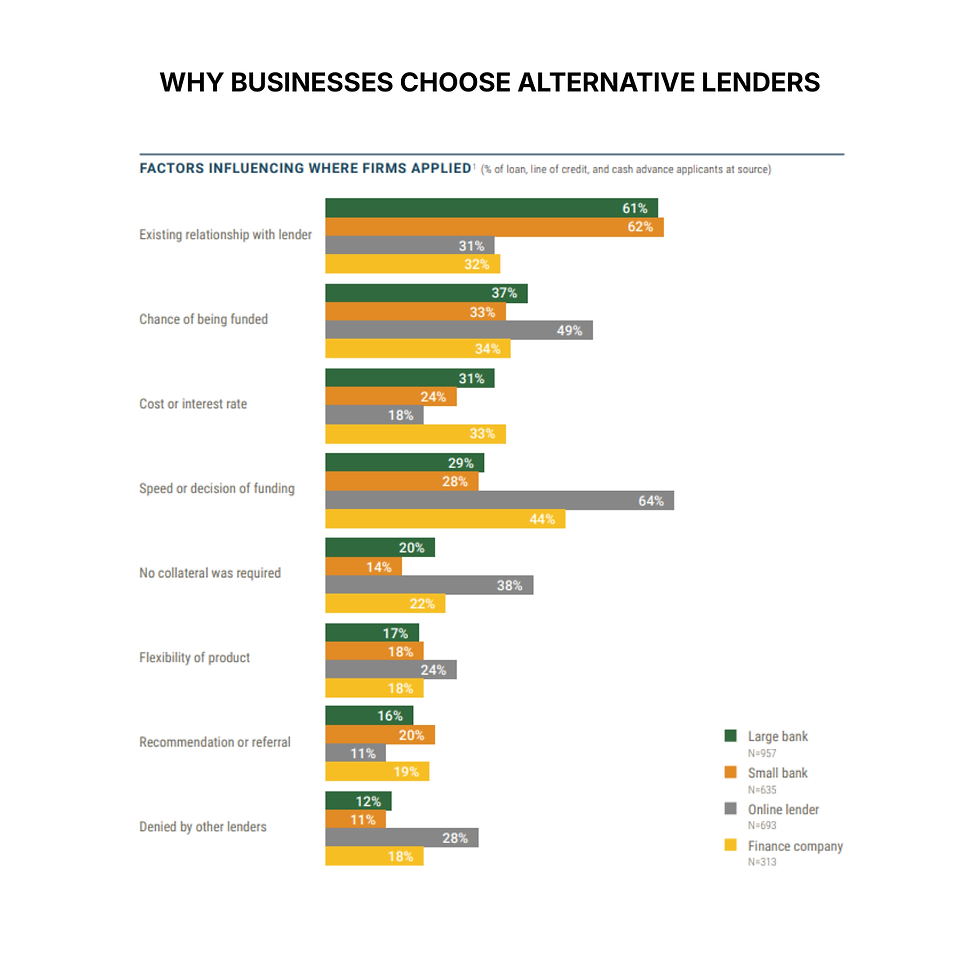
I've been reviewing the Federal Reserve's 2026 Small Business Credit Survey, and one statistic on page 17 stopped me cold.
When businesses choose online lenders, 64% cite speed of funding as their deciding factor. For traditional banks? Just 20%.
That's not a gap. It's a chasm.
And honestly? It tells us everything we need to know about how small businesses actually operate in the real world.
The Time Value of Capital
We talk a lot about the time value of money in finance. But for small business owners, it's really about the time value of opportunity.
Here's what the data shows:
Online lender priorities:
Speed of funding: 64%
Chance of being funded: 49%
Cost or interest rate: 33%
Large bank priorities:
Existing relationship: 61%
Chance of being funded: 37%
Speed of funding: 20%
Notice something? Rate doesn't even crack the top two for either group.
I find that fascinating. We spend so much time arguing about basis points and APR, but that's not what business owners are thinking about when they're in the trenches.
Why Speed of Funding Wins Every Time
I've worked with hundreds of small business owners. And I can tell you: they don't wake up thinking, "I hope I can wait six weeks for a loan approval today."
They wake up thinking:
"How do I make payroll Friday?"
"Can I afford to buy this inventory before my competitor does?"
"What if this equipment breaks down next week?"
These aren't hypothetical scenarios. They're Tuesday.
Let me give you a real example. Last year, I worked with a restaurant owner whose walk-in refrigerator died on a Thursday afternoon. She had a three-day weekend coming up—her biggest revenue window of the month. A bank loan would've taken 30-45 days minimum. She went with an alternative lender, got funded in 48 hours, replaced the unit, and kept her business running.
Did she pay more in interest? Absolutely. But the cost of waiting would've been catastrophic. Spoiled inventory. Lost revenue. Angry customers. Maybe even permanent damage to her reputation.
When a restaurant owner needs to replace a broken refrigerator, they're not comparison-shopping interest rates. They need it fixed NOW before they lose thousands in spoiled inventory.
When a contractor gets offered a big job but needs to buy materials upfront, they can't wait for a bank committee to meet in three weeks. The job goes to whoever can move fastest.
The Real Competition Isn't Rate, It's Time
Here's what I find really interesting in this data: even though 60% of online lender borrowers report higher-than-expected borrowing costs, they still choose speed.
Think about that. They're literally paying more for faster access to capital. And they're doing it willingly.
Why? Because the cost of waiting often exceeds the cost of borrowing.
Let me give you an example:
Scenario A: Wait 45 days for a bank loan at 8% APR
Scenario B: Get funded in 3 days at 15% APR
If that capital lets you capture a time-sensitive opportunity worth 30% margin, which is actually cheaper?
The "expensive" fast loan wins every time.
I'll admit, I used to be skeptical about this. Early in my career, I thought anyone choosing a higher-rate loan was making a mistake. But I've learned that small business owners are actually doing sophisticated math—they're just calculating it differently than I was.
They're factoring in opportunity cost. The revenue they'll lose by waiting. The deals that will slip away. The competitive advantage that disappears if they move too slowly.
What This Means for Business Owners
If you're reading this and thinking, "I should probably establish a relationship with a fast lender before I need one," you're absolutely right.
The businesses that thrive aren't the ones that scramble for funding in a crisis. They're the ones that:
Know their options in advance
Understand the true cost of waiting
Have relationships with multiple funding sources
Match the funding type to the opportunity timeline
I know, I know, it's not sexy advice. "Build relationships before you need them" isn't exactly a viral headline. But it works.
The Bottom Line
The Federal Reserve data confirms what I've seen in practice: speed of funding isn't a nice-to-have feature. It's the primary reason businesses choose alternative lenders.
And honestly? That makes perfect sense.
In small business, opportunities don't wait. Competitors don't wait. Payroll doesn't wait.
So why should funding?
Look, I'm not saying alternative lending is always the right choice. Sometimes waiting for a bank loan makes total sense. But when time is critical, business owners are voting with their feet, and the data shows they're choosing speed over everything else.
Can't blame them for that.


